Tuesday, November 15, 2016

new projects

Getting all kinds of things in order.  My new baby just arrived.  He's eating like a little champ.  He sure poops a lot though, and he's grumpier then an old coal miner without any chewin' tabacky.

picture

So, one of the things I'm trying to get done is to organize my online projects:
That's pretty much everything.  I'm not naturally a super-organized kind of person, but having a family really puts pressure on you to get things sorted out, or let go of stuff.  It's just so chaotic sometimes.  I haven't had a chance to take a shower in ages.  I smell pretty ripe, but my wife is getting some rest and the baby is being grumpy right now, probably because his momma isn't available.

He's so cute and he smells so yummy (new baby smell), but he likes his mommy and he only barely tolerates me.  Maybe it's all because I'm always sniffing him and munching on his little fingers.

Things still to do:
  • Sort out domains
  • Remove / rewrite junk
  • rough out articles
  • register with aff.

Monday, February 15, 2016

Biologically active fertilizer

My experiments with anaerobic composting have led me to develop a liquid fertilizer with dramatic results.  Crops that are grown using this formula are strong and healthy.  Fruit that is produced using our methods are often larger and sweeter with a more pronounced flavor profile then fruits which are grown in soil without biological monitoring and control.


Soil bacteria and other beneficial microorganisms are a part of a complex process which was designed by nature to provide the roots of the plants with the chemical compounds which they require to generate healthy growth. 


For example, there are fungi in the soil which are capable of increasing the effective surface area of your plants roots by a multiple of 40. 

Thursday, January 28, 2016

graceful lotus flower in repose


true art is never truelly understood


true royalty has more to do with the quality of your soul


love is a many splendored thing


have you found happiness yet?


what ai am up 2

 I love my wife, which apparently is a strange thing to some people.  I love her from the beginning of time til well after all time ceases to exist.  She is my infinite love.

Being infinite is peacefully chaotic if you're attempting to make any kind of sense out of it.  My heart goes out to you.  I pray for your children's perception of you.  I pray for your relationship with your family to be healthy and balanced.  I pray for you.

I pray for your health.  I pray that you find the healing and love that the earth feels for you.  It is waiting for us all to find it.  We shall grow more prosperous as life goes on.

It's been another sunny day today.  Too many folks were a part of my life today.  It was chaotic at times, riding the various filaments and tendrils through the infinite void.  Cleaning, walking, sharing, finding, repairing, knowing.

She is an amazing young woman, and I love her.  I love my wife, which apparently is a strange thing to some people.


Loving your wife will not always be a challenge.


Living is never not a challenge.


Flowers are beautiful.


Growth is not optional.

Thursday, December 24, 2015

increasing productivity

It's been a rough week.  Christmas is approaching and I still don't have a pikachu toy for my daughter.  She has piles of toys laying around in her room and boxes and boxes of all kinds of stuff for us to wrap for her tonight, but still no pikachu.  grr.

Stuff going on with me:
  • researching shopify
  • Bill Gates' blog
  • things to be thankful for
  • cleaning up the house
Also researching plants to start growing in my new grow box that is finally operational after several weeks of designing, building, testing etc.

  • winter savory - $2/pck, 10g/$16
  • goji - $16/kg
  • corsican basil - $3.25
  • holy basil - $3.25
  • oregano - $2.50
  • white sage (salvia apiana)
  • wild sagebrush plants
  • big sagebrush
  • wyoming sagebrush
  • fringed sagebrush
  • allheal
  • maralroot
  • sea buckthorn
  • santolina
  • roseroot
  • jiaogulan
  • wild strawberries
  • alpine strawberries
  • moringa
  • zaatar - $7
I have so much available.  Some via cuttings of plants that are already growing, some via seeds that I've collected, some via purchased seeds or plants.  It's such a huge decision, it really eats up my time and attention.  Currently I have space for 3 trays, which works out to about 3600 plants, depending on the method that is used.  The full capacity of the grow box is about 4 times that, and will require some extra building, wiring etc.  

Time to sell-able product is a major factor, since a plant that can get sold in half as much time is twice as profitable.  I really like the sagebrushes because they're so beautiful, but I doubt the capacity for other people to appreciate them.  We'll see.  I'm leaning towards one tray of goji and paulownia, one tray of sages and sagebrushes and one tray of strawberries and other herbs that are already available.  The lighting of the box may work well for some and not so well for others.


I'm working on building some shelves that have higher luminance so that the seeds and plants which require higher light densities to germinate and grow will have a greater chance of flourishing.  Also, the different shelves have different colors of light, so I'll be learning about what colors of light work for different plants etc.

Back to cleaning up for Christmas. 

Wednesday, December 16, 2015

Apple booger recipe

This makes about a cup of yummy appley booger slime.

1/4 cup tapioca starch (or rice starch or probably corn starch as well)
1 cup apple juice

Warm it up until the starch congeals while stirring and you (and your kids) can have fun slopping and slurping it or whatever you do with such things.  It also makes an excellent pie filling, but you may want to add butter, brown sugar and a pinch of salt before wrapping it with your favorite pie crust or bun recipe.

Have you saved someone's life today?

Goals and successes are the nutritious food for a positive mind-set.


Honest prayer is the key to the magnificent power of righteousness.


We feed and care for everyone on the planet.


You're beauty is unparallelled.


There is work to do. 


This world belongs to us and to our children.


The production of true prosperity requires honesty and correctly focused effort.


What does your child know of God?


What do you produce?


Friday, December 4, 2015

BodyWeight exercises

My schedule is pretty crammed sometimes and getting that extra little pump really helps get through the day and keep your energy and activity levels up.  I keep a pair of free-weights handy whenever possible to get some reps in when my daughter is in the shower etc.  Bodyweight exercises can also be a great way to tone up your abs and you can do them anywhere, anytime.

Bodyweight exercises are also a great way to tone your core and i really need to build up my core.


 My favorites:
  1. V-ups - From laying position, touch toes, balancing on buttocks
  2. Russian Twists - Trunk twists while sitting on floor with feet out in front
  3. Flutter Kicks - Raise your feet off floor while lying on your back
  4. Bicycle Kicks - Cross-over situps alternating elbows to opposite knee
  5. Plank - 30 seconds on your elbows
  6. Side Plank - On one elbow

References:

Tuesday, December 1, 2015

Carbeurator Tuning

I have a 1981 Toyota Pickup that is having some fuel consumption issues.  It's a great old vehicle and it will be out of smog requirements pretty soon, which is when I plan on converting it to natural gas or e-fuel, depending on what's available in our area.  In the mean time, I need to tune the carbeurator so that it can pass smog and reduce pollution.  It's been sitting in my driveway for a while now, just looking pretty.


So the problem that it has is black smoke from the exhaust, paired with excessive fuel consumption.  It's a pretty straightforward carburettor, so it shouldn't be too difficult for me, although I'm not any kind of car repair expert. First step for me is to clean out the jets.

front view of aisin carb (single jet)

It's an Aisan 2 barrel carburetor, at least I think it is, except that it only has one jet.  The carb has to be removed from the engine in order to access the main jet, even though the main jet access bolt is easy to remove, it's just at an odd angle and I can barely see inside the port, let alone figure out how to get the darn thing out and cleaned.  Ordering a complete kit is $53 at Napa.com.  I may only need the lower flange gasket, which is $1.53.  I guess the next step is to remove the bugger and see what is going on.  Coolant is drained, most of the fuel is out of the carb itself. 


view of carb from engine side

Found a gash in one of the vacuum hoses.   Repaired it and put it all back together to see if it runs now. 

view of carb from passenger side
Sounds better.  Now to set timing and calibrate carburetor.

view of carb from behind
Then off to have smog checked.


References:

Sunday, November 8, 2015

RX833 750W Power supply

Tracking down some schematics

http://www.rcgroups.com/forums/showpost.php?p=17023400&postcount=408

Wow, that is a loud fan.  I guess it's even louder when it doesn't have a server rack wrapped around it.  Sounds like a jet getting ready to take off.  That's really unfortunate.  It's more efficient then then an array of HPS.  All 12V also, so only real danger is that the power supply will go out.  It's a pretty safe device.  62A possible output, 40A expected output.

LED's (50k hrs)
Picture by Paul Sober
Those are banana plugs for the 12V connections and the switches are single throw, double pole, but only one side is used.  Next step is drilling channels for wires to power each array of LEDs.  So excited that the power supply is all wired up etc.   My 5 year old daughter was helping me with the wiring and had some very interesting questions about the internal workings of the power supply.


Saturday, November 7, 2015

Kids books

Some ideas for children's books
  • Emma plants an apple seed
  • Emma learns about farming
  • conserving water / water use
  • composting
  • some kind of a textbook


Picture by Paul Sober


Things to do:
  • Clean
  • fix toilets
  • work on truck
  • build garden boxes
  • drop compost (into soil)
  • clean side yard
So much to do.  I guess that's just a symptom of living in an actual environment.

Emma and I are thinking about making some books for her to read, using the words that she knows.  She's an excellent reader and knows all her words from school, plus the ones that she's learned on her own.  

Wednesday, October 28, 2015

Book Progress

Finished first rough draft of chapter one, "A growth event" of the book about how composting is going to save the world.  It's a pretty good book so far.  It's called, "FutureHope" for now.  I'm still not %100 sure about the book title, but it's good enough for now.  Actually, the first chapter was written all at once and I've just been editing and re-working it, over and over, until at some point, it will be more like a real first chapter of a meaningful and important literary work.


I'm pretty excited about this project.  The table of contents is up as well, although I keep coming up with better chapter titles.  For instance, I'm considering adding a chapter about medical waste and how it will change in order to become more sustainable, and the title for that proposed chapter would be, "healthy people are good for the environment", or maybe, "healthiness is good for our planet".  Something like that.

Essentially, I would really like to have a solid chapter and a clear table of contents before I approach any publishers about actually getting published.  That includes crowd-funding sources.  There are so many!

bokashi composting

Once the idea is clear and some of the writing is completed, it would be good to get some funding to support the research that must be completed in order to fill in the spaces in the subject matter and to develop some graphics and stuff.

Other stuff to do:
  • Fix truck
  • Complete crowd sourcing information
  • Make/find letter for publishers
  • Print/reread chapter 1
  • Finish moving stuff in garage
  • Build new garden boxes
  • Clean compost buckets

It's not that composting is going to save the world, exactly.  I mean, there's so much work to do, but good composting technique is at the end of all the different channels, turning organic waste into an important agricultural product that builds soil and increases fertility and productivity.  Without composting, all that bio-waste has the possibility of becoming environmentally destructive instead of profitable and beneficial.

Completed bokashi compost
With composting, bio-degradable waste is just another beneficial input.  Paper products, food waste and even organic medical waste are all compost-able.  Outputs from gasification plants and from sewage digesters are also excellent inputs for industrial composting operations.

My composting processes are rapid and insect and odor free.  There may be some dispute about the philosophical facets of my composting beliefs, but my processes promote positive biological growth by controlling the bacterial and fungal populations in the sludge, and eventually, in the ground.  My output is capable of eradicating many bacterial and fungal problems in fruit orchards.  These statements are provable.

With funding, we would be able to obtain a property and some vehicles and other machinery so that we could begin collecting and processing food waste in this area.  Once the system is proven, it would be possible to begin consulting other similar operations around the country and around the world.

Back to growing plants for now.  My creative well just seems to have dried up.  I'll keep posting articles about the types of technology that I'm looking at  but I don't think a lot of progress is going to be made on the book.  It's just time consuming and I have to rewrite stuff a lot to make it clear and precise and remove any kind of writing that sounds like propaganda rather then a straightforward discussion of technology and how the natural progression of that technology is producing systems that are beneficial for the environment and how that natural progression is going to change many different facets of modern industry.

The book is written in my head, but I can't seem to get it out.  I write a little and then stop and then I re-read it and it sounds like garbage and I have to rewrite the entire thing and it lacks flow and read-ability or intellectual ergonomics or something.  The writing just seems bulky and non-fluid, rather then communicating the connectivity between so many seemingly unrelated technologies. 

Friday, October 23, 2015

Low light Crops

These plants are excellent as a secondary crop, with the primary crop being something that provides shade and space in the rhizosphere.  Separating the roots of plants that do not 'live well' together is an excellent way to control fertilization of both.

santolina cuttings
This is all proprietary information.  Use at your own risk.

  • Jiaogulan - A wild mountain herb, jiaogulan thrives in mountain environments, under the canopy, where it uses trees and shrubs for structure, making dense clouds of biomass inside the forest.  Jiagulan is commonly cultivated inside screen buildings, where it is easily controlled and contained.
  • Goji - Originally a wild plant known as boxthorn, goji grows well in adverse environments and produces  protein in the form of nutritious leaves or berries.  The young shoots are a prized delicacy and packed with nutrition.
  • Malabar Spinach - A climbing vine that is not only nutritious, but also delcious, tasting like a crisp butter lettuce, but without the possibility of bolting.  In fact, it just keeps growing and producing the warmer it gets.  The tiny baby leaves make little purple hearts in your salads. 
  • Wormwood - Generally not considered edible, due to toxic compounds, wormwood has many excellent qualities and can produce a crop in places where water availability is low.  Check with your local agricultural office to ensure that it is considered safe in the area where you intend to cultivate it.
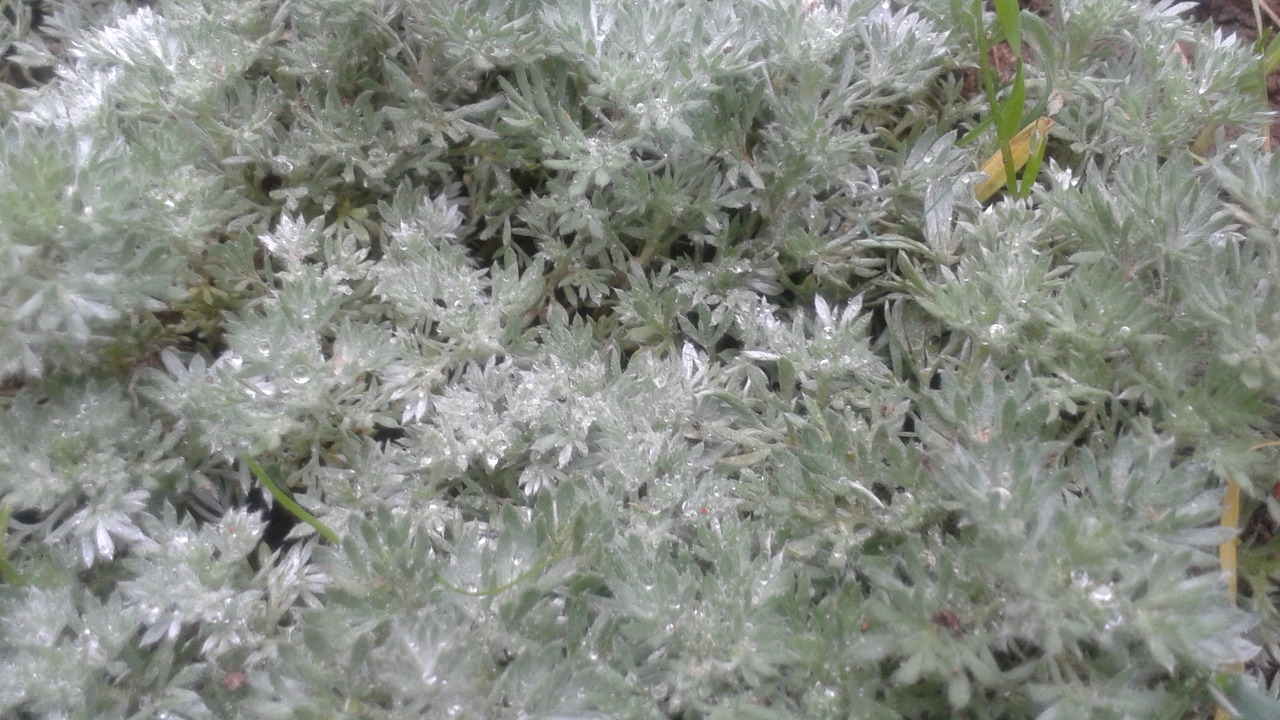
  • Fringed Sagebrush - A low growing shrub, with a soft appearance, Fringed Sagebrush is commonly used as a ground cover and appears as a silver carpet wherever it is cultivated.  Taller varieties produce tall plumes of fluffy silver foliage that sparkle in the morning dew.

The roots of wormwood deter the roots of competing plants and is considered invasive in North Dakota.  The other plants on this list have already naturalized in various parts of the US without significant consequence.

goji seedlings
 Dual crops is experimental business and any specific pairings should be tested prior to committing resources to large-scale production.

References:

1001 All-natural secrets to a pest-free property

1001 All-natural secrets to a pest-free property is the name of a book, written by Dr. Myles H. Bader, about one of my favorite subjects, the death and otherwise non-presence of pests without the use of chemical pesticides.  Plant-based solutions tend to be more effective in many cases.  Growing your own is a great way to test and develop new products and to test for effectiveness of your solutions.
Research for one of these projects usually takes a year or so.  Overlapping projects is a great way to compound the learning from each.  For instance, learning new calculus or differential math terms is a great way to increase your ability to retain and utilize linguistic concepts.

low water requirement plants that are also insect repelling
fringed sagebrush
lumber trees
  • paulownia
  • balsa
  • ash
  • birch
  • poplar
 Other insect repelling plants

Tuesday, October 20, 2015

salinity waste mitigation project

Patents are issued by the U.S. Patent and Trademark Office (PTO).  Duration is approximately 20 years.

Current project is a utility patent.  Project is a process for producing a useful, concrete and tangible result.  It definitely has utility.  I have never known it to be used in this way before, so that it may be novel.  It may also be non-obvious to someone who is knowledgeable in that field.

algae culture

Project

A system of algae production is possible that reduces total sodium ion content by cultivating algae in waste water with added nutrients.  Added nutrients are generally beneficial to rhizosphere and increase value for irrigation.  Additional requirements may be a bacterial treatment to mitigate harmful compounds prior to cultivation.


References:

Friday, October 9, 2015

Discussion of agriculture in third world countries

Over the last decade or so, chemical fertilizers are being used increasingly in third world countries.  This is a good thing in some ways and a negative thing in other, perhaps more important ways.

First of all, it is good that poorer, undereducated people are able to use modern technology to increase harvests and more food is a good thing.  Especially in these places where people are having trouble getting nutrition.  Nutrition is getting more and more difficult to produce for the growing populations, so it's a good thing that they're able to produce more food.

One negative consequence of this increase is that there is more chemical run-off of fertilized water from the fields, into waterways, which eventually reach the ocean.  Phosphorous, Nitrogen and Potassium, the major elements of chemical fertilizers, are important elements for healthy plant growth.  Unfortunately, when suspended in water, they are also useful for growing algae.  Algae in the ocean or in large bodies of water, reduce evaporation from those bodies of water.

If large portions of the ocean were to get covered over with algae, then our planet could become a desert planet.  I would expect the temperatures to continue rising, and for the atmosphere to dry out.  Less cloud cover means less light is reflected back out into space, so that the problem is self-compounding.  Many of the problems that are due to carbon debt behave similarly.  The problem causes other problems which exacerbate the problem even more.

My take on the problem is that we need educated people to get involved with managing these land resources.  If there is a limited quantity of arable land in the world, and it's getting more and more important to our growing population, then why is it being managed by the poorest, most uneducated people on the planet?  I have seen some efforts by Bill Gates and others to educate these people, but it seems like it's mostly geared towards getting them to use the fertilizers, rather then getting them to use sustainable farming techniques to grow more food without the negative impacts associated with modern fertilization techniques.